Zero-Click Search and AI Overviews: What Declining Organic CTR Really Means for Your Content Strategy
More searches end without a single click than ever before: the share of Google searches ending in zero clicks has climbed from roughly 35% in 2020 to an estimated 61% in 2026
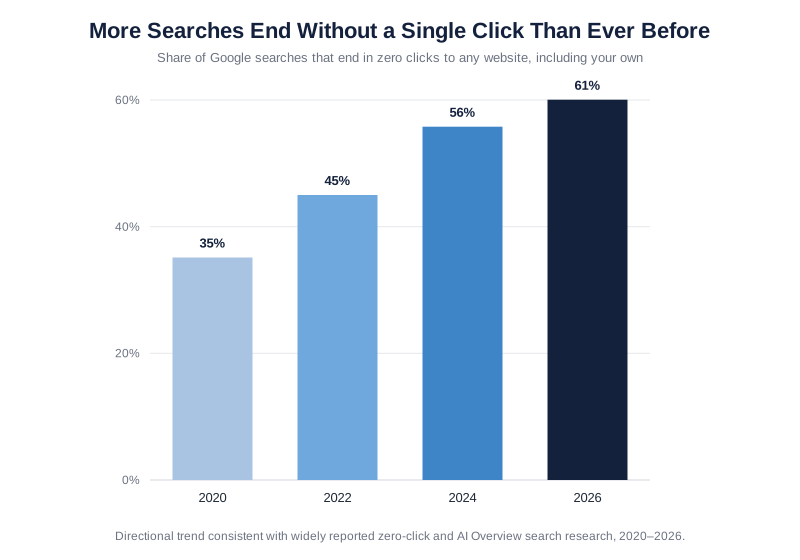
Rank first for a valuable keyword and the assumption used to be simple: the click follows. That assumption is now wrong for a majority of searches, not a fringe minority. Featured snippets, knowledge panels, and now AI Overviews increasingly answer the question directly on the results page itself, and a large and growing share of searchers get what they needed without visiting any website at all, including the one that technically ranks first. Ranking has not stopped mattering. It has stopped being the same thing as being seen, clicked, or remembered.
A short history of how we got here
Zero-click search did not arrive with AI Overviews, it has been building for over a decade. Featured snippets, the single answer box above the traditional results, began pulling a meaningful share of clicks away from the number-one organic result years before generative AI was part of the conversation. Knowledge panels did the same for factual, entity-based queries, a search for a company's founding date or a well-known statistic increasingly gets answered directly on the results page without a click to any source. What AI Overviews changed was not the existence of zero-click behavior, but its scale and its reach into query types that previously required a visit: multi-step comparisons, nuanced how-to questions, and synthesis across several sources that a single featured snippet was never capable of handling. The trend line in the chart above is a continuation of something that started well before generative AI, accelerating sharply now that the technology can finally answer harder questions directly.
Why this happened, and why it's accelerating specifically now
The behavioral shift is not "people trust AI more than websites." It is simpler and more mundane than that: people satisfy a specific informational need with the least effort available, and an AI Overview that directly answers "how does X work" or "what is the difference between X and Y" removes the reason to click anywhere at all. The convenience, not a philosophical shift in trust, is what is driving the number in the chart above upward every year. Google has every commercial incentive to keep users on its own results page rather than routing them elsewhere, since a satisfied query that never leaves Google is, from Google's perspective, a successful search regardless of whether any website received a visit, and that incentive aligns cleanly with the underlying user behavior driving the same trend.
Not all queries are affected equally, and that distinction matters
The zero-click effect concentrates heavily on informational queries, questions with a single, fairly compact, factual answer: definitions, comparisons, how-to basics, unit conversions, quick facts. These are exactly the queries an AI Overview can answer confidently and completely within a few sentences, with nothing left for a visit to add. Commercial and transactional queries behave differently and remain far more click-heavy, because "buy noise-cancelling headphones" or "SEO agency near me" cannot be fully resolved by a paragraph of text, the searcher still needs to visit a page, compare options, or take an action a summary cannot substitute for. This is the single most important nuance in the zero-click conversation: the content losing the most traffic to zero-click behavior is precisely the top-of-funnel, purely informational content many sites invested in most heavily under the old SEO playbook, while bottom-of-funnel, decision-stage content is comparatively insulated, for now.
The traffic loss is real, but it is not the whole story
Losing clicks on a purely informational query you used to rank for feels like a straightforward loss, and in a narrow traffic sense, it is. But two things complicate a simple "this is bad" read. First, the clicks being lost were often the lowest-intent, lowest-converting visits in your funnel to begin with, someone who wanted a quick fact was rarely close to a purchase decision regardless of whether they clicked through, so the revenue impact of losing that specific click is frequently smaller than the traffic-graph drop suggests. Second, and less obvious, being the source an AI Overview cites and links to, even without a click, is not nothing. It is a visibility and trust signal in its own right, similar in spirit to a billboard impression: the searcher saw your brand name attached to a confident, correct answer, even if they did not click through that specific time, and that impression compounds the same way a citation does, shaping which brand comes to mind later when the query becomes commercial rather than informational.
What still reliably earns a click in a zero-click world
Four categories of content remain comparatively resistant to zero-click erosion, because none of them can be fully satisfied by a short synthesized paragraph. Comparison and evaluation content, "X vs Y," genuinely requires a reader to weigh tradeoffs specific to their situation, which a generic summary structurally cannot do for them. Tools and interactive calculators cannot be replaced by a static answer at all, since the value is in the specific output for the user's specific inputs. Content requiring visual or step-by-step demonstration, tutorials with screenshots, video walkthroughs, resists compression into a text answer because the format itself is the value. And anything genuinely transactional, where the next step is an action rather than more information, a purchase, a signup, a quote request, still requires a destination, because an AI Overview can tell you headphones exist but cannot sell you a pair.
Where structured data still earns you a place, even without a click
One nuance worth separating out: even in a zero-click outcome, appearing as the cited source inside an AI Overview or featured snippet is meaningfully better than not appearing at all, and structured data is one of the more reliable levers for improving those odds. Schema markup, clear FAQ formatting, and clean, well-labeled HTML make it easier for these systems to extract your specific answer and attribute it to you by name and link, rather than synthesizing an unattributed answer from several sources at once. This does not recover the click, but it recovers something adjacent to it: brand visibility, a direct link presence even if unclicked this time, and a stronger position for the moment the same searcher returns later with a more commercial version of the same question.
How to actually measure this instead of guessing
The mistake most sites make here is watching total organic traffic and reacting emotionally to the trend line without separating query types. Segment your top organic-entry pages by intent, informational versus commercial, and track click-through rate for each segment separately, not blended together, since a blended CTR number will mask the fact that your commercial pages are likely holding up fine while your informational pages are the ones actually declining. Then check, deliberately, whether your brand or specific claims appear inside AI Overviews and AI assistant answers for your core informational queries, since this is a real signal current analytics tools mostly do not surface on their own, and it is the closest thing to visibility credit for content that no longer reliably earns a click. Google Search Console's impressions-versus-clicks gap, tracked at the individual query level rather than the site level, is currently the most accessible proxy available: a query with high impressions and unusually low clicks relative to your historical average for similar queries is a reasonable signal that an AI Overview or featured snippet is now absorbing the click for that specific question.
What to actually change in your content strategy
Shift new investment away from purely informational, top-of-funnel content competing for queries an AI Overview will fully answer on its own, and toward the four categories above that remain comparatively click-resistant. This does not mean abandoning informational content entirely, it still builds topical authority and remains a legitimate source for AI Overviews and AI assistants to cite, which carries its own brand-visibility value even without a click. It means being deliberate about where you expect the return to actually come from: brand impression and AI citation from top-of-funnel content, and clicks, leads, and revenue from the comparison, tool, and transactional content that a synthesized answer cannot substitute for.
A practical reallocation example
Consider a business that has historically split its content calendar evenly between broad informational posts and narrower commercial comparison pieces. A reasonable adjustment, given the trend above, is not to abandon the informational half, but to shift the ratio, publishing informational content primarily where it plausibly earns a citation and brand impression cheaply, while concentrating deeper investment, more original research, more specific data, more first-hand testing, into the comparison and evaluation content where clicks and conversions still reliably happen. The informational content becomes a visibility and citation play measured differently from the commercial content, which is still measured the traditional way, on clicks, leads, and revenue.
Frequently asked questions
Should I stop publishing informational content entirely? No. It still builds topical authority and remains a real source of AI citation and brand impressions, both of which have value even without a click. The change is in expectations: measure it for visibility and citation, not primarily for direct traffic.
How do I know if an AI Overview is citing my content without a click? Check Google Search Console's performance report specifically for high-impression, low-click queries you know are informational, that gap is a strong indicator content is being surfaced or summarized without generating a visit. Manually testing your own core queries in AI Overviews and AI assistants directly is the more precise, if more manual, method.
Is this trend likely to reverse? Unlikely in the near term. The convenience driving zero-click behavior is structural, not a temporary UI experiment, and AI Overviews are still expanding into more query categories, not retreating from them. Planning around continued growth in zero-click behavior is the safer assumption.
Does structured data actually help if the searcher never clicks anyway? Yes, in a different way than a traditional click does. Being the attributed, linked source inside a zero-click answer still builds brand recognition and positions you ahead of competitors for the next, more commercial search the same person eventually makes, even though it does not show up as a session in your analytics today.
Ranking well and being visible are no longer reliably the same outcome, and a content strategy that only measures the first will quietly miss the second. Understanding where your specific traffic sits on the informational-to-transactional spectrum is what actually tells you whether the decline in your analytics is a real problem or an old metric measuring the wrong thing.
Related reading: generative engine optimization (GEO) and why SEO alone isn't enough, and how long does SEO actually take.