Generative Engine Optimization (GEO): What It Is and Why SEO Alone Isn't Enough Anymore
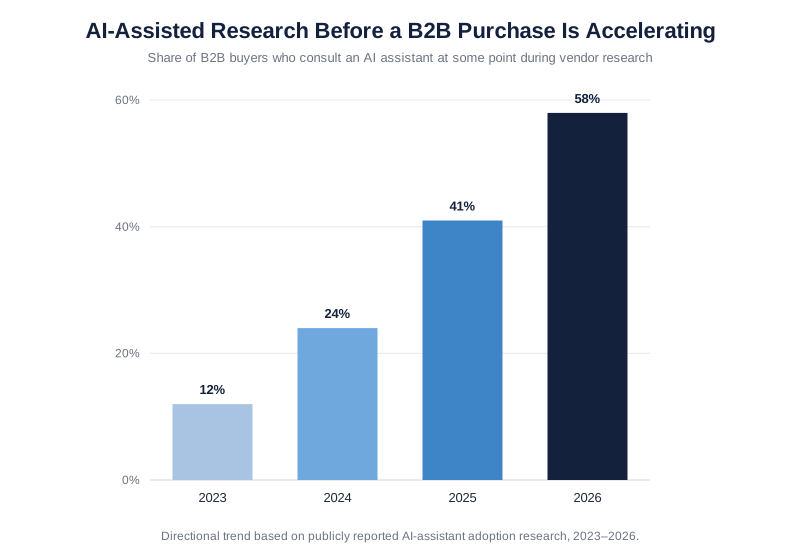
AI-assisted research before a B2B purchase is accelerating: illustrative growth from roughly 12% of buyers in 2023 to an estimated 58% in 2026
For twenty years, ranking well meant one thing: showing up on the first page of Google. That is no longer the only surface that decides whether a buyer finds you, and for a fast-growing share of research sessions, it is not even the primary one. A buyer now just as often asks ChatGPT, Perplexity, or Google's own AI Overview a direct question, gets a synthesized answer with two or three named options, and never sees a traditional results page at all. Optimizing only for classic SEO while that shift happens is optimizing for a shrinking share of how buyers actually find businesses.
What Generative Engine Optimization actually is
Generative Engine Optimization, GEO, is the practice of making your content the kind of source an AI system chooses to cite when it generates an answer, rather than the kind of page a search algorithm chooses to rank. The distinction matters because the two systems are evaluating fundamentally different things. A search engine ranks pages, presents ten blue links, and lets the human decide which one to click and trust. A generative engine reads across many sources, synthesizes them into a single answer, and makes the trust decision on the buyer's behalf before they ever see your name, unless it decides to include you. You are not competing for position ten anymore. You are competing for inclusion at all.
The term itself is new enough that its definition is still settling, but the underlying discipline it describes is not speculative. Every major AI assistant with web access, and every AI Overview Google now shows, is already making citation decisions today, on every relevant query, whether or not the businesses being cited or excluded are aware it is happening. GEO is simply the deliberate practice of understanding and influencing those decisions instead of being a passive, unaware input into them.
How GEO differs from traditional SEO in practice
Traditional SEO rewards pages that satisfy a specific search intent precisely, backed by backlinks and on-page signals a crawler can parse deterministically: title tags, header structure, internal linking, page speed, keyword placement. Every one of those signals still matters, a page that isn't crawlable and indexable in the first place cannot be cited by anything downstream of that index. But GEO adds a second, different layer of scrutiny happening at generation time, not crawl time. AI systems weigh whether a source states a clear, extractable answer instead of building slowly to a conclusion; whether the content contains specific, checkable facts, numbers, and named examples rather than general assurances; whether other independent sources corroborate the same claim; and whether the source reads as a genuine, first-hand account rather than a rewritten summary of what other pages already said. A page can rank on page one of Google for its target keyword while still never getting cited by an AI engine's answer to the same underlying question, because ranking and citability are measuring different things.
There is also a structural difference in how visibility gets distributed. A traditional search results page can show ten businesses, so even the business ranking eighth still gets a placement and a chance at a click. A generative answer typically names two or three sources at most. Being the fourth-best answer to a question, in a system that only surfaces the top two or three, functions identically to not existing at all for that query. This compresses the competitive field considerably: SEO rewards being good enough to make the first page, GEO rewards being good enough to make the short list an AI system is willing to commit to by name.
Why the timing on this matters right now
The chart above is illustrative, not a single verified statistic, but the direction it describes is not in serious dispute: AI-assisted research before a purchase decision has gone from a novelty to a routine step for a meaningful and growing share of buyers, in the span of a few years. Two consequences follow directly from that shift. First, the businesses that get cited early, while the pool of well-optimized GEO content is still small, tend to keep getting cited, because AI systems that already trust a source as a reliable answer to a given question have limited incentive to displace it once a newer, unproven source appears asking the same question. Early, genuine authority compounds here in much the same way domain authority compounded in classic SEO. Second, and less discussed, the businesses being left out of these answers are frequently not being outranked in any conventional sense. They simply never come up, because nothing about their content signals "cite me" to a system that is optimizing for confident, well-supported answers rather than topical relevance alone.
There is a third, quieter consequence worth naming directly: because so few businesses are deliberately optimizing for this yet, the bar to be noticed is currently lower than it will be once GEO becomes a standard line item in every competitor's marketing plan, the way "we should do SEO" became standard two decades ago. The businesses moving on this now are effectively claiming citation territory before it becomes contested.
What actually makes content citable
Four properties show up repeatedly in content that AI engines choose to cite, and none of them are exotic.
A direct, extractable answer near the top. Generative engines pull the specific sentence or short passage that answers the question cleanly, they do not synthesize your entire argument from a page that builds context for six paragraphs before stating a conclusion. If your best insight is buried under three paragraphs of preamble, it is functionally invisible to an engine that is extracting, not reading in full.
Specific numbers, named entities, and first-hand detail. "Many businesses see improved results" is not citable. "We tested this across 40 client sites over six months and saw a median 22% lift" is, because it is a concrete, checkable claim rather than a vague assurance, and specificity is exactly the signal that separates a first-hand source from a rewritten one.
Structured, well-organized formatting. Clear headers, short paragraphs, and genuine lists make content easier for a generative system to parse and lift cleanly, the same structural discipline that has always helped human skimmers now directly helps machine extraction too.
External corroboration. If your claim about your own product appears only on your own domain, it is a marketing claim. If the same underlying fact is also referenced in an independent review, a forum discussion, or a comparison article you did not write, it becomes a verifiable fact an engine can cite with more confidence, which is why earned mentions on third-party platforms carry outsized weight for AI visibility specifically, not just for backlinks.
Common mistakes businesses make when they first attempt GEO
Treating it as a rewriting exercise. The most common mistake is taking existing, general marketing copy and simply adding a few statistics to it, without changing the underlying substance. AI engines are not fooled by surface-level specificity bolted onto a claim that is still fundamentally generic. The number has to be genuinely load-bearing to the claim, not decorative.
Chasing every possible query instead of the ones that matter. Businesses sometimes try to make every page on their site maximally citable, which spreads effort too thin to matter anywhere. The higher-leverage approach is identifying the small number of commercial-intent questions your actual buyers ask an AI assistant before choosing a vendor, and making sure those specific answers are unambiguously strong, rather than attempting broad coverage of every tangentially related topic.
Ignoring the technical floor entirely. Some businesses hear "GEO is different from SEO" and conclude technical SEO no longer matters. It matters more than ever as a prerequisite, because a page an AI crawler cannot access or parse cannot be cited regardless of how well-written it is. GEO adds a layer on top of technical SEO. It does not replace it.
Fabricating specificity instead of earning it. Inventing a precise-sounding statistic to make a page appear more citable is a short-term trick that fails the moment it is checked, and increasingly, generative systems cross-reference claims against other sources before treating them as reliable. Manufactured precision is a worse long-term strategy than honest generality, because it eventually damages the trust signal instead of building it.
A worked example: two competing pages, one question
Picture the query "how long does it realistically take to see SEO results." Page A is a competent, keyword-optimized article: a strong title, solid on-page structure, ranks respectably on page one. It states, in general terms, that "SEO takes time and results vary." Page B ranks slightly lower on a traditional SERP, but states plainly, near the top: "Most sites see initial ranking movement within 90 to 180 days, and a meaningful traffic increase, on the order of 10x, typically by month 18, based on documented publishing timelines." When an AI engine answers this question, it is far more likely to cite Page B, not because it ranks higher in the traditional sense, but because it contains a concrete, extractable, checkable claim that satisfies the question directly, while Page A requires the engine to either paraphrase vague reassurance or skip the source and look elsewhere. Traditional SEO would have told you Page A is "winning." GEO tells a different, and in this case more consequential, story.
How to actually audit your own citability
Running this check yourself does not require special tooling to start. Write down the five to ten commercial-intent questions your actual buyers ask before choosing a business like yours, the same questions a prospect might type into ChatGPT instead of Google. Run each one, verbatim, against two or three major AI assistants, and record plainly whether you are mentioned, and if so, in what context, favorably named, mentioned in passing, or absent entirely while competitors appear. For any question where you are absent, go find the specific page on your site that should be answering it, and check it honestly against the four citability properties above: does it state a direct answer near the top, does it contain specific rather than generic claims, is it well structured, and is the underlying claim corroborated anywhere beyond your own domain. Whichever property is weakest is usually the highest-leverage place to start.
Where GEO and SEO reinforce each other
None of this replaces SEO fundamentals, it depends on them. A page cannot be cited by an AI engine if it was never crawled or indexed in the first place, so the crawlability, site architecture, and technical health work that underpins classic SEO is still the floor everything else stands on. What changes is what you optimize for once that floor is solid: not just "does this rank," but "does this contain the kind of specific, well-corroborated, cleanly extractable claim that a generative system would choose to lift and attribute to us by name." The businesses that will be visible in both search results and AI-generated answers over the next few years are the ones treating these as complementary layers of the same underlying discipline, not competing priorities to choose between.
Frequently asked questions
Do I need to rewrite all my existing content for GEO? Not all of it, prioritize the pages that already answer commercial-intent questions your buyers ask. Add a direct, specific answer near the top, add concrete numbers or named examples where you currently have general claims, and you have addressed most of what citability actually requires without a full rewrite.
Can I measure whether AI engines are citing me? Yes, directly. Run the actual buyer-style questions your prospects would ask through ChatGPT, Perplexity, and Google's AI Overview and note whether, and how, you are mentioned. This is a different, and currently under-measured, signal from anything a standard rank tracker reports.
Is GEO a passing trend or a permanent shift? The specific engines and interfaces will keep changing, but the underlying behavior, asking a system a direct question and trusting its synthesized answer, is a genuine change in how people research, not a temporary novelty. Treating it as permanent now costs little and positions you ahead of competitors still optimizing purely for the search results page.
Does company size affect how achievable this is? Less than most businesses assume. Citability rewards specificity and genuine first-hand substance, not domain authority or marketing budget, which means a small business with real, concrete expertise in a narrow area can be cited ahead of a much larger competitor whose content on that same narrow question is comparatively generic.
This is exactly the gap a proper AI visibility check is built to close: running your actual buyer-style queries against real AI engines, checking whether you are mentioned at all, and if so, how favorably, then tying the fix directly to the specific content and structural changes that make a source citable in the first place. Ranking well and being cited well are both achievable. They just are not the same project.
Related reading: why ChatGPT doesn't know your business exists, and zero-click search and AI Overviews.