How Long Does SEO Actually Take?
Most answers to "how long does SEO take" give you a single number, somewhere between three and six months, occasionally stretched to twelve. That number is not wrong, but it is close to meaningless on its own, because it ignores the variable that matters most: how old your domain actually is. A 90-day-old domain with 40 ranking keywords is ahead of schedule. A three-year-old domain with 40 ranking keywords is in serious trouble. Same number, opposite diagnosis, and a generic timeline cannot tell you which one you are looking at.
The evidence for the domain-age effect
Search engines do not evaluate a new site the same way they evaluate an established one. A 2025 Ahrefs study analyzing more than one million URLs found that the average top-ranking page is five years old, and only 13.7% of pages holding a top-10 position are under a year old. That is a striking gap, and it is the clearest available evidence that domain and page age carry real weight in how competitive rankings actually shake out, regardless of what any single ranking factor guide claims in isolation.
Worth being precise about here, in the interest of not overstating the case: Google's own John Mueller has repeatedly said there is no deliberate "sandbox" penalty applied to new sites, a position he restated as recently as 2021. What Google's public statements attribute the delay to instead is the accumulated time needed for indexing, signal accumulation, and algorithmic evaluation, not a punitive holding pattern. In practice, this is close to a distinction without a difference for a business waiting on results. Whether you call it a deliberate sandbox or simply the natural time cost of accumulating enough trust signals, the observed outcome is the same: SEO professionals across the industry continue to observe a 3-to-9-month trust evaluation phase for new domains in 2026, during which rankings are suppressed relative to what the same content would achieve on an established domain, while search engines verify the site's entity and monitor for low-quality or AI-generated spam patterns. For planning purposes, treat the mechanism as academic and the timeline as real.
Realistic keyword benchmarks by domain age
These ranges assume active, consistent publishing, not a one-time content push followed by silence. They are meant as a sanity check, not a guarantee, and they get less useful the further out you go, since by year two, execution quality matters far more than domain age.
| Domain age | Typical ranking keywords | Keyword mix | What's actually happening |
|---|---|---|---|
| 0 to 90 days | 0 to 100 | Almost entirely branded and long-tail | Indexing and initial trust accumulation, minimal ranking authority yet |
| 90 to 180 days | 100 to 500 | Still mostly long-tail, informational | Trust evaluation phase in progress, this is where most founders start to panic prematurely |
| 6 to 12 months | 500 to 2,000 | Commercial-intent terms begin appearing | Trust evaluation phase typically lifting, if it applied |
| 1 to 3 years | 2,000 to 10,000+ | Full spread, transactional terms compounding | Domain age no longer the limiting factor, content quality and backlinks now dominate |
Realistic ranking-keyword benchmarks by domain age: 0-100 keywords at 0-90 days, 100-500 at 90-180 days, 500-2,000 at 6-12 months, and 2,000 to 10,000+ at 1-3 years, on a log scale
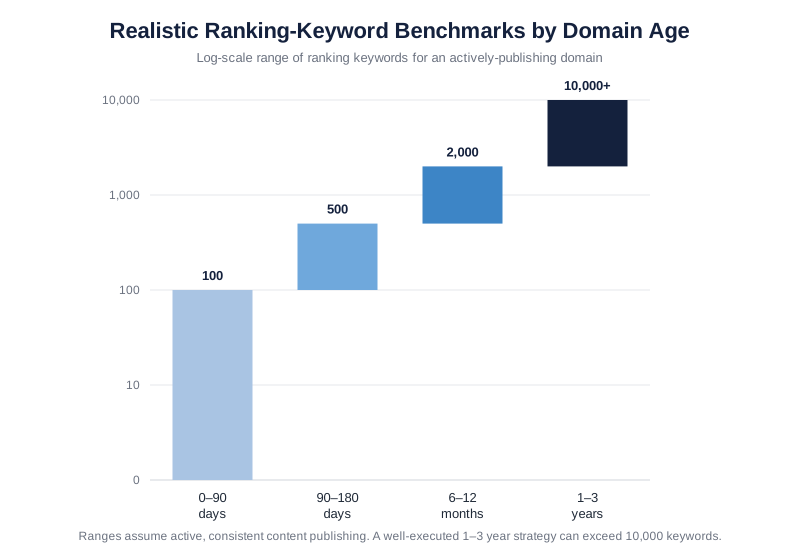
If your numbers are meaningfully below the range for your domain's age, the cause is almost never "SEO doesn't work." It is usually a short, findable list of specific issues: inconsistent publishing cadence, content targeting keywords with no real search volume, technical issues suppressing indexation, or content that is thin relative to what is already ranking for the same terms.
What to measure while you wait, since rankings lag everything else
Waiting three to six months for keyword and traffic movement without measuring anything in between is how good SEO work gets mistaken for failure. Three leading indicators move well before rankings do.
Indexation speed. Is newly published content actually getting crawled and indexed within days rather than weeks. If new pages are not appearing in index checks promptly, no amount of content quality matters, because the content has not even entered the race yet.
Keyword intent shift. Early on, rankings should skew informational (how-to, guide, what-is content). Over time, as trust accumulates, the mix should shift toward commercial and transactional terms, comparison language, pricing-adjacent queries, buying-intent phrasing. If that shift has not started by month six to nine, the content strategy itself is likely the issue: the site may be answering questions instead of addressing the terms buyers actually use when they are close to a decision.
Competitor trajectory. A domain the same age as yours, in the same category, growing keywords twice as fast is a far more useful signal than any absolute number, because it controls for the domain-age variable entirely. If a same-age competitor is meaningfully ahead, the gap is in execution, not in how search engines treat new domains, and that is a fixable, specific problem rather than a waiting game.
Why the compounding curve makes patience worth it
The reason this timeline matters enough to get right is that organic growth, once it starts compounding, produces a return curve that looks nothing like the flat early months suggest. One documented case tracked a SaaS company's real trajectory: roughly 1,000 monthly organic visitors by month five, 10,000 by month eleven, and 50,000 by month eighteen (industry SEO ROI research, 2026). That is not linear growth, it is compounding growth that was invisible for most of the first two quarters and then accelerated sharply. Businesses that invest in long-term SEO report average returns of up to 700%, and at the 24-month mark, top-performing campaigns exceed 10 times return on investment, specifically because year-two returns build directly on top of year-one content rather than starting over. Comparing a content investment to a paid campaign over a 3-month window will always make paid look better, because content has not had time to compound yet. The fair comparison window is a minimum of 12 months, ideally 24.
Frequently asked questions
Is the Google sandbox a real, official ranking penalty? Google's official position, restated by John Mueller as recently as 2021, is no. What is well documented instead is a 3-to-9-month period where new domains accumulate the indexing history and trust signals needed to rank competitively, which produces the same practical outcome regardless of what it is called.
Can you buy your way out of the waiting period? Not reliably. Aggressive link building or content volume on a very new domain does not bypass the trust accumulation window and can sometimes trigger the exact spam-monitoring scrutiny the evaluation period is designed to catch.
What if my domain is old but my rankings still look like a new site's? That is the more serious diagnosis. An established domain underperforming its age bracket usually points to a specific, fixable issue, thin content, technical indexation problems, or a content strategy that never moved past top-of-funnel keywords, rather than anything related to domain trust.
How do I know if I'm actually behind schedule versus just impatient? Compare your numbers to the age bracket above, and separately check your keyword intent mix against the expected progression. If both are on pace, the honest answer is that the timeline itself, not your execution, is the current constraint.
"How long does SEO take" is the wrong question asked alone. The better question is: given our domain's age, are we tracking ahead, on pace, or behind the range businesses like ours typically see, and has our keyword mix started the informational-to-commercial shift it should have by now. That reframe turns an anxious, open-ended wait into a benchmarked, checkable process, and it is usually the difference between a team that stays patient through the slow months and one that abandons a strategy right before it was about to compound.
Related reading: paid ads vs. organic: the real ROI math, and zero-click search and AI Overviews.