Paid Ads Are a Rental, Not an Asset: The Real Math on Paid vs Organic
Rent an apartment for ten years and you have a decade of receipts. Buy one and you have equity. Paid advertising and organic growth (SEO, content, reputation) follow exactly that distinction, and most marketing budgets are allocated as if the two were interchangeable line items competing for the same dollar. They are not, and the underlying ROI math, once you actually run it over a long enough window, makes the difference hard to ignore.
The cost side of the ledger is deteriorating, with numbers behind it
Customer acquisition costs have risen 60% over the past five years and 222% over eight, with the increase accelerating rather than leveling off, up another 18.4% year over year in the most recent full year of data (Genesys Growth, 2026). For paid search specifically, average B2B CAC has reached roughly $802, Google Ads cost-per-click rose nearly 13% year over year, and shopping ad CPCs jumped almost 34% (Phoenix Strategy Group; SHNO, 2026). The median SaaS company now spends two dollars in acquisition cost for every one dollar of new annual recurring revenue it brings in. None of this is a temporary blip. Increased competition for the same auction inventory, privacy changes limiting tracking and attribution, and larger platforms bidding up shared keyword pools are structural pressures, not cyclical ones.
Here is the part that budget conversations often skip: a rising CAC environment does not just make paid acquisition more expensive, it makes the entire channel structurally worse at compounding, because the price you pay for a click today tells you nothing about the price tomorrow. Every period starts from zero. There is no accumulated discount for having advertised well last quarter, unlike an organic asset, which keeps producing precisely because you already paid for it once.
The organic side of the ledger, with the same rigor applied
The comparison is only fair over a long enough window, since comparing content to paid over a three-month period will always make paid look better, content has not had time to compound yet. Run the comparison over 12 to 24 months instead, and the picture reverses sharply. Long-form SEO content delivers roughly a 748% ROI for B2B companies specifically, compared to about 36% ROI for PPC over the same measurement window (industry SEO ROI benchmarking, 2026). SEO-sourced leads close at a rate of roughly 14.6%, versus 1.7% for outbound marketing leads. Businesses that commit to a long-term SEO strategy report average returns up to 700%, and at the 24-month mark, top-performing SEO campaigns exceed 10 times return on investment, precisely because year-two returns compound directly on top of everything published in year one rather than starting the ledger over.
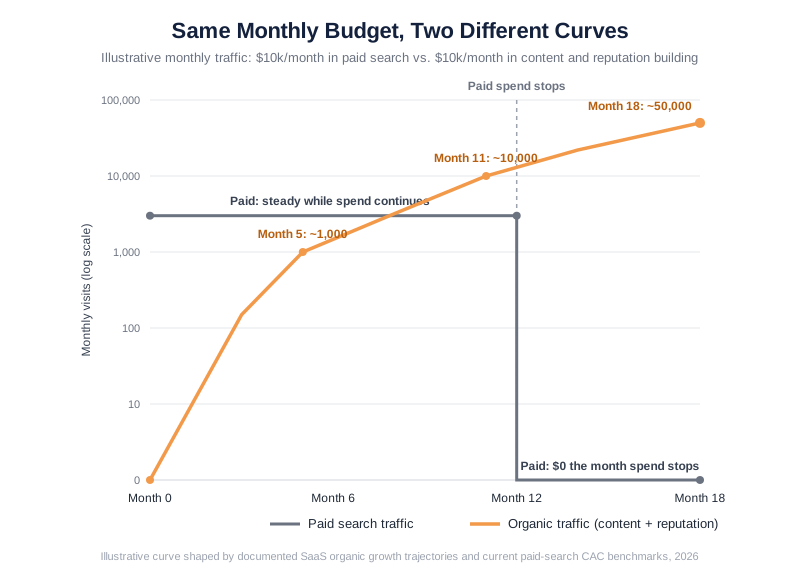
A documented real-world trajectory illustrates the shape of this curve concretely: one SaaS company's organic traffic went from effectively nothing to roughly 1,000 monthly visitors by month five, 10,000 by month eleven, and 50,000 by month eighteen. That is not a straight line. It is a curve that looks unimpressive for most of the first two quarters and then compounds sharply, which is exactly the shape that makes organic investment easy to abandon right before the inflection point, if you are only measuring in three-month windows.
A worked example: the same $10,000 spent two different ways
Same monthly budget, two different curves: paid search traffic stays flat while spend continues and drops to zero the month it stops, while organic traffic compounds from 0 to roughly 1,000 monthly visits at month 5, 10,000 at month 11, and 50,000 at month 18
Assume a business spends $10,000 a month on paid search at a blended CAC in line with current B2B benchmarks, and separately, a business invests the same $10,000 a month into content and reputation building (writing, editing, review platform outreach, structured publishing).
At month three, the paid spend has produced a predictable, steady stream of leads proportional to that month's spend, and nothing more. Stop spending, and the pipeline stops within days. The content investment, over the same three months, looks comparatively unimpressive: modest traffic, few conversions, a library that is still building topical authority. On a quarterly report, paid wins decisively, and this is exactly the comparison that leads most businesses to conclude organic "doesn't work" for them.
By month eighteen, using the documented traffic curve above as a reference shape, the content investment has typically reached a scale of organic traffic that would cost multiples of the original monthly spend to replicate through paid channels at current CPC rates, and it continues to produce that traffic the following month for no additional cost. The paid investment, over the same eighteen months, has produced eighteen months' worth of leads at a steadily rising per-lead cost, and produces exactly zero additional leads the month spend stops. Total cumulative spend across both approaches may be similar. Total remaining value the day after spend stops is not: the organic investment retains nearly all of its earning capacity, the paid investment retains none.
This is not an argument against paid ads
Paid has a real job, and for some businesses, it is the right job at the right time. Very early on, before any organic presence exists at all, paid can generate immediate signal and immediate revenue while organic surfaces are still being built, and organic realistically takes months to gain traction, especially on domains without an established history (see the domain-age research on ranking timelines for the specifics). It is also the correct channel for time-bound demand: a launch, a seasonal push, an event, anything with a clear start and end date where you are deliberately buying attention for a specific window rather than trying to own a topic long-term. And it remains a legitimate lever for retargeting warm audiences who already know the brand, where acquisition cost is naturally lower because the trust-building work already happened elsewhere.
The mistake is not using paid. The mistake is using paid as a permanent substitute for organic rather than a bridge to it, and never noticing the difference because both show up as undifferentiated "traffic" on the same dashboard.
The question that actually matters
Before allocating budget, the useful question is not "which channel has the better return this month." It is "which of these are we renting, and which are we building." A business that has run paid ads for two years with organic rankings that look identical to day one has been renting the entire time, and has nothing to show for it the moment the budget gets cut, which it eventually will, because paid budgets are typically the first line item to shrink in any downturn. A business that invested the same two years in content, reviews, and a clear competitive position has an asset that keeps producing whether or not next quarter's budget survives, and per the ROI benchmarks above, that asset is likely still accelerating rather than flattening at that point.
Frequently asked questions
Does organic ever fully replace paid? Rarely entirely, and it does not need to. The healthiest mix uses paid for what it is genuinely good at, immediate, time-bound, retargeted demand, while organic handles the compounding, always-on discovery layer that keeps working regardless of this quarter's budget decisions.
How do I know if my organic investment is actually on the compounding curve or just stalled? Compare your trajectory against the documented shape above: modest growth through month five to six, a clear acceleration by month eleven, and a much steeper climb by month eighteen. If month twelve looks the same as month six, the issue is more likely execution (content quality, publishing consistency, or targeting keywords with limited demand) than the channel itself.
Is it ever right to cut organic investment when budget gets tight? This is the single most common mistake in the data. Because paid stops producing the instant spend stops while organic retains its earning capacity, cutting the organic budget first during a downturn destroys the asset that was about to become cheaper than paid, precisely when a lower-cost channel would matter most.
The businesses winning the next few years of rising acquisition costs will not be the ones spending the most. They will be the ones who correctly identified, early and with a long enough measurement window, which parts of their growth were rented and shifted deliberate effort toward the parts that compound instead.
Related reading: how long does SEO actually take, and zero-click search and AI Overviews.