Why ChatGPT Doesn't Know Your Business Exists
Ask ChatGPT what the best tool is in your category. Then ask Perplexity the same question. Then ask Gemini. If your business does not show up in any of the three answers, the reason is almost never bad luck, and it is rarely something your existing SEO checklist would have caught. It is the result of a specific, measurable mechanism: AI engines pull from a narrow set of sources, weight them in ways that have nothing to do with your Google ranking, and most businesses have never looked closely enough to know where they stand.
This is not a marginal channel anymore. Roughly 37% of consumers now say they begin research with an AI tool rather than a traditional search engine, and more than three in four have used AI to help with a shopping or purchasing decision in the past six months (Search Engine Land, 2026). Adoption keeps climbing month over month, and for some categories, the share of buyers consulting AI somewhere in their purchase journey is approaching half. The mechanics of how these engines decide what to say about you are now a legitimate, researchable discipline, and the data on that mechanism is more specific, and more actionable, than most businesses realize.
Ranking and being recommended are governed by different systems
A page can hold position one on Google and still be completely absent from an AI assistant's answer, because search engines and AI engines are structurally different products solving different problems. Google returns a ranked list of documents and lets a human synthesize an answer. An AI engine has already done the synthesis before the buyer sees anything. It reads across a set of sources, forms a point of view, and hands the buyer two or three names. If your business is not on that short list, your Google ranking is irrelevant to the moment that actually decides whether you get considered.
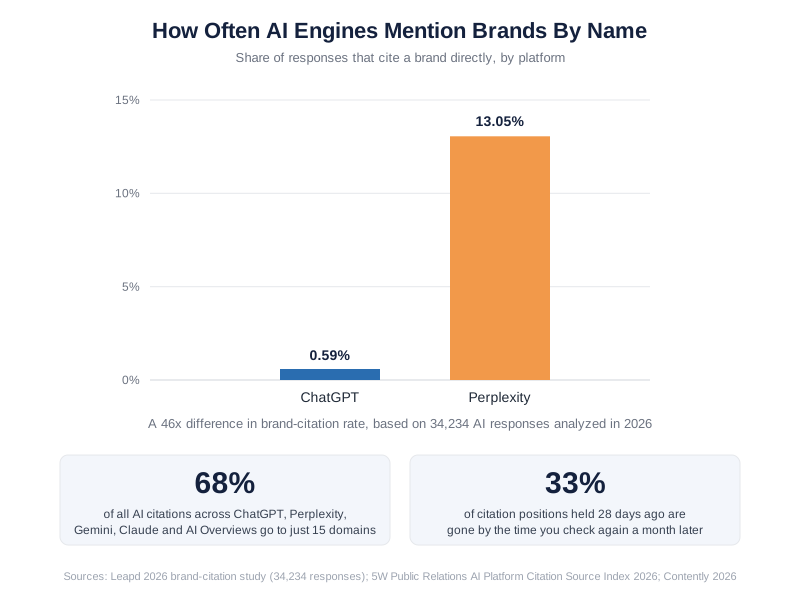
The scale of the concentration problem is larger than most SEO professionals expect. A 2026 industry analysis synthesizing more than 680 million individual AI citations across ChatGPT, Google AI Overviews, Perplexity, Gemini, and Claude found that the top 15 domains capture 68% of all consolidated citation share, a concentration far more extreme than anything seen in traditional Google PageRank distribution (5W Public Relations, 2026). Reddit is the single most-cited source across every major AI engine, appearing in roughly 40% of citations. Wikipedia dominates ChatGPT specifically, accounting for 26% to 48% of its top-10 citation share. This means that for a huge share of buyer questions, the AI engine's answer is being shaped primarily by what a handful of community and reference sites say, not by anything on your own website, no matter how well it is optimized.
Platform behavior also varies enormously, which matters if you are only testing one engine and assuming the result generalizes. A separate 2026 study of 34,234 AI responses found a 46-fold difference in brand citation rates between platforms: ChatGPT cited brands directly in only about 0.59% of responses, while Perplexity cited brands in roughly 13.05% (Leapd, 2026). ChatGPT also cites only around 15% of the pages it actually retrieves during a query, and of the citations it does make, 44.2% come from the first 30% of a page, meaning content buried below the fold is functionally invisible to it even when the page itself was retrieved. If your product information lives three scrolls down a long homepage, you may be getting retrieved and still never cited.
How often AI engines mention brands by name: ChatGPT cites brands directly in 0.59% of responses versus 13.05% for Perplexity, a 46x gap, while the top 15 domains capture 68% of all AI citations
Why strong SEO does not automatically transfer
Three specific mechanisms explain the gap between organic ranking and AI citation, and each one points to a different fix.
AI engines weight earned media over owned content. Content that a third party wrote about you (a comparison article, a review platform listing, a Reddit thread where someone recommends you) outperforms your own brand-owned content for AI citation by roughly 325% (Contently, 2026). This is close to the opposite of how traditional SEO works, where your own domain authority is the primary lever. Here, what other people and platforms say about you carries dramatically more weight than what you say about yourself, because the engine is trying to synthesize an independent-seeming answer, and it treats third-party sources as more trustworthy evidence of that independence.
Structure determines whether content is extractable, not just readable. Pages with clean structure and schema markup earn roughly 2.8 times higher AI citation rates than poorly structured pages, and content with proper schema markup is about 2.5 times more likely to appear in AI-generated answers at all (LangSync; Averi.ai, 2026). FAQPage schema specifically improves AI citation rates by around 30% on average, because it pre-formats content into the exact question-answer shape these systems prefer to extract from. Pages using three or more schema types (commonly Article or HowTo combined with Author, Organization, and FAQ markup) show meaningfully higher citation likelihood than pages using none. None of this shows up in a standard technical SEO audit focused on crawlability and page speed, which is exactly why a site can pass every traditional SEO check and still be structurally invisible to an AI parser.
Citations are volatile, not stable. The citation retention rate over a 28-day window averages just 33% across five major AI platforms (Contently, 2026), meaning two-thirds of citation positions that existed a month ago are gone by the time you check again. Traditional SEO rankings, once earned, tend to be relatively sticky for months. AI citations behave more like a rolling snapshot of whatever content the model currently judges most relevant and best-structured, which means this is not a project you finish once. It is a surface you monitor continuously, the same way a paid campaign requires ongoing management rather than a one-time setup.
A framework for auditing your AI visibility
Testing this yourself does not require special tooling, just discipline and a consistent method, which is the same one used inside a full digital presence audit's AI Engine Visibility surface. Build 8 to 10 queries a real buyer would type into an AI assistant, spanning the full buying journey rather than just the obvious one.
Category discovery is the broadest layer: "what are the best tools for [job to be done]" or "what tools can help me [primary task]." Problem-aware queries assume the buyer does not know solutions exist yet: "how do I solve [problem]" or "is there a way to automate [task]." Solution-aware queries assume active comparison: "[competitor] vs [your product]" or "what's the best alternative to [competitor]." Vertical-specific queries add industry context: "best [category] tools for [your niche]." Recommendation-seeking queries mimic how people actually talk to AI assistants in conversational, first-person language: "I run a [type of business] and need help with [problem], what should I use."
Run every query against ChatGPT, Perplexity, and Google's AI Overviews (visible directly inside search results for many queries). For each response, record four things: whether your product is mentioned at all, whether it is recommended outright or just listed among options, what position it appears in (first-mentioned carries the strongest signal), and critically, where the engine says it pulled its information from. Perplexity in particular surfaces its source URLs directly, which turns this from a guessing exercise into a concrete list of exactly which third-party pages are shaping how the world's AI assistants describe you, and therefore exactly where outreach and content effort should go first.
What actually moves the needle, and how long it takes
Once the gaps are mapped, fixes tend to fall into a tight set of categories, and the honest timeline matters because this is not an instant win. Foundational technical work, schema markup, FAQ structuring, front-loading direct answers within the first 30 words of a section, typically takes 4 to 8 weeks to start registering in citation behavior. Authority-building through third-party mentions and cross-platform presence (the G2 listings, the Reddit threads, the comparison articles that are the actual source material for most AI answers) takes longer, generally 3 to 6 months, but most businesses that execute consistently see measurable citation improvement within the first 90 days.
Because earned media outperforms owned content so dramatically for this specific purpose, the single highest-leverage move for most businesses is getting listed and reviewed on the platforms AI engines already trust: G2, Capterra, Reddit communities relevant to the category, and any comparison or roundup content in the space. Publishing your own content that states facts plainly (pricing, concrete use cases, direct named comparisons to competitors) gives models something extractable to work with, but it will never fully substitute for third-party validation, because the entire mechanism is built to favor independent-seeming sources over self-description.
Why this cannot be fixed in isolation
AI visibility is a downstream output of your reputation on review platforms, the structural clarity of your own content, and how distinctly you are positioned against named competitors elsewhere on the internet. A business that treats AI visibility as a standalone checkbox, rather than the output of everything else it does across its digital presence, will keep applying fixes to the wrong layer. This is exactly the kind of cross-surface pattern a full digital presence audit is built to surface: not just whether you show up in an AI answer, but which upstream gap, a missing G2 listing, an unstructured homepage, a thin comparison presence, is actually causing the absence.
Frequently asked questions
Is AI search visibility the same thing as SEO? No. They share some inputs (content quality, topical authority) but are measured and won differently. SEO rewards your own domain's authority and relevance. AI citation systems disproportionately reward third-party validation and structurally extractable content, and the two can diverge sharply, as shown by cases where well-ranked sites are still absent from AI answers.
How often should I re-test my AI visibility? Given a 28-day citation retention rate of only around 33%, a quarterly check is the minimum. Businesses actively working on this surface typically test monthly.
Does this apply to smaller or newer businesses too? Arguably more so. Because there is no entrenched incumbent advantage yet in this channel the way there is in decades-old Google rankings, a smaller business that becomes the clearest, most citable source of truth about its own category can outperform a much larger, better-known competitor here.
If you have not tested how AI engines currently describe your business, that is the place to start. The buyers asking these questions are not waiting for you to catch up, and the citation data shows the field re-shuffles roughly every month.
Related reading: generative engine optimization (GEO) and why SEO alone isn't enough, and the silent reputation gap on G2 and Trustpilot.