The Silent Reputation Gap: Why Not Being on G2 or Trustpilot Is an SEO Problem, Not Just a Trust Problem
Most businesses treat review platforms as a customer trust issue: get some stars up, respond to complaints, move on. That framing misses the bigger cost, and the data on both sides of it is more specific than most reputation advice acknowledges. An empty or thin listing on G2, Capterra, or Trustpilot is not just a missed trust signal. It is a missed SEO asset with a measurable domain authority behind it, and increasingly, a missed AI visibility asset, both of which are far more expensive to rebuild later than they are to build now.
The buyer-behavior numbers make this hard to dismiss
94% of B2B buyers use online review sites to make purchase decisions, and G2's own research puts the figure at 84% (Clutch; G2, cited via B2B SaaS Reviews). Among buyers who use review sites, 89% say they "often" or "always" check them before buying any business software, and more than half consult reviews throughout the entire buying journey, not just at the start, with majority usage across awareness, consideration, and decision stages alike. For software specifically, reviews influence 98% of B2B buyers. This is close to a universal step in the buying process, and if your listing does not exist or is thin, buyers do not skip the step. They use a competitor's listing instead, or they encounter a comparison page you had no input into and no ability to correct.
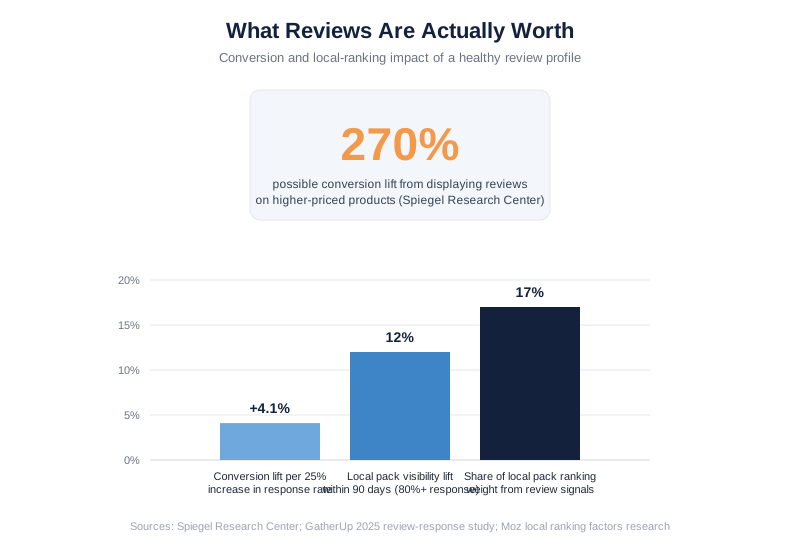
The conversion math backs this up with real numbers, not just sentiment. Displaying reviews can increase conversion rates by up to 270% for higher-priced products, according to the Spiegel Research Center, and 65% of consumers say they are more likely to choose a business that responds to its reviews. Response behavior specifically, not just review volume, carries measurable weight: for every 25% increase in response rate, conversion rates improve by roughly 4.1%.
What reviews are actually worth: a 270% possible conversion lift from displaying reviews, a 4.1% conversion lift per 25% increase in response rate, a 12% local pack visibility lift within 90 days, and a 17% share of local pack ranking weight from review signals
Why this is also, specifically, an SEO problem
Review platform pages routinely outrank vendor websites for exactly the searches that matter most: comparison terms, "best of" roundups, and alternative-to queries. This is not a vague claim, it shows up directly in the domain authority numbers. G2 carries a Domain Rating of 91, backed by 65.7 million backlinks and roughly 49,800 referring domains, and organic search alone drives just over half of its desktop traffic, itself growing more than 43% month over month in recent measurement (Semrush, Similarweb, Concurate, 2026). Capterra sits in the same competitive tier. No single vendor's own website is going to out-rank that kind of accumulated authority on a comparison query, no matter how well-optimized the vendor's homepage is. Being unlisted does not mean you lose a tie on these searches. It means you are not in the running at all, while your competitors' listings absorb the traffic and comparison intent that would otherwise have been contestable.
This compounds with a second, newer effect: these same review pages are frequently the exact source material AI engines cite when a buyer asks for a recommendation. Perplexity shows its citations directly, and community and review-adjacent sources like Reddit and G2-style listings are among the most commonly cited sources for product recommendation queries across every major AI engine. A business absent from these platforms is not just missing from a webpage. It is missing from the raw material AI assistants pull from when constructing an answer, which means the gap shows up twice: once in traditional search, once in AI search, and the AI search gap is arguably harder to notice because there is no ranking report to flag it.
Reviews are also a confirmed local ranking factor, with a specific number attached
For any business with a local or location-based component, this is not a soft correlation. Moz's ranking factor research attributes roughly 17% of local pack ranking weight directly to review signals. A 2025 GatherUp analysis found that businesses responding to 80% or more of their reviews saw an average 12% lift in local pack visibility within 90 days, and businesses that respond to 100% of reviews see a 5 to 10% ranking boost over businesses with lower response rates. Most SEO professionals observe measurable ranking shifts within 30 to 90 days of starting a consistent response strategy, depending on how competitive the local market is. This is one of the few SEO levers with both a fast feedback loop and a directly attributable mechanism: respond consistently, and the ranking movement tends to follow within a single quarter.
The fix is unusually cheap relative to the cost of ignoring it
This is the part that makes the gap frustrating rather than just unfortunate. Listing on G2 and Capterra is free and takes roughly 30 minutes. A Product Hunt launch is a one-time effort that generates backlinks, social proof, and an initial traffic burst, with returns that compound well past the launch day itself. None of this requires a meaningful budget. It requires someone to decide it is a priority, which is exactly where most businesses fall down, because reviews get filed under "support" or "brand," not under "growth," and so nobody with a growth mandate ever picks it up.
What to check, in order of leverage
Basic presence. Are you listed at all on G2, Capterra, Trustpilot, and Product Hunt, and if a competitor comparison page exists for your category, are you even named as an option in it. Absence here is the highest-priority fix because it is binary. You either exist in the conversation or you do not, and given the domain authority numbers above, you cannot out-rank your way around it with your own site alone.
Review velocity and recency, not just star rating. A 4.8 rating built from twelve reviews, the most recent fourteen months old, reads very differently to a careful buyer, and to an AI engine weighing recency, than a 4.4 rating with ninety reviews and steady recent activity. Consistency over time is doing more work here than the headline number.
Response rate. Given the direct link between response rate and both conversion (4.1% lift per 25% increase in response rate) and local ranking (a 12% visibility lift at 80%+ response rates within 90 days), this is one of the cheapest, most measurable improvements available in the entire reputation surface.
The credibility paradox. Does your product's marketing promise something your actual review content quietly contradicts. A company promising "effortless setup" with reviews that repeatedly mention a difficult onboarding process is handing skeptical buyers the exact contradiction they need to justify walking away. This is worth fixing at the product or onboarding level, not just the review-response level, because buyers researching carefully will find the pattern regardless of how individual responses are worded.
Competitive gaps. Which roundup articles mention competitors and not you, which comparison pages exist for their name and not yours, which platforms they are active on that you have not touched. This is usually the most actionable list you will build, because each gap on it is a specific, addressable task rather than a vague directive to "improve reputation."
Frequently asked questions
Does responding to negative reviews actually help, or does it just draw attention to them? The data says it helps. A visible, professional response to a negative review is itself a trust signal to future readers, and response rate correlates with both conversion and ranking improvements regardless of the sentiment of any individual review being responded to.
How many reviews do we actually need before this becomes a real asset? There is no hard threshold, but the recency and velocity pattern matters more than any specific count. Ninety recent, steadily accumulating reviews with an average rating in a believable range outperform a higher but stagnant rating with a handful of old reviews.
Is Product Hunt still worth it if we are past our initial launch window? The backlink and one-time traffic burst are strongest at initial launch, but re-launches for major product updates are a legitimate and commonly used way to capture a second wave of the same benefit.
Reputation as infrastructure, not PR
The businesses that treat review platforms as SEO and AI visibility infrastructure, backed by domain authority numbers most vendor sites cannot match on their own, are building a compounding asset for very little upfront cost. The businesses that leave it to chance are not avoiding the cost, they are just paying it later, in the form of a comparison page they never got to influence and an AI answer that recommended someone else.
Related reading: why ChatGPT doesn't know your business exists, and competitor analysis belongs in every audit.