Manual Audits Are Quietly Killing Your Agency's Close Rate
Same prospect, two very different response times: a manual audit built by hand takes 2 to 3 hours, an evidence-backed audit generated automatically takes under 5 minutes
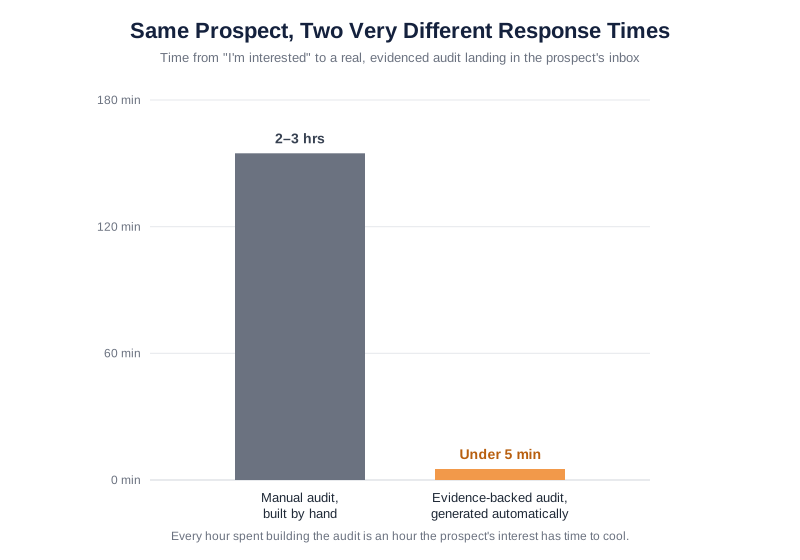
Every agency owner knows the manual audit ritual: a prospect shows interest, and someone on the team spends two to three hours pulling reports, screenshotting issues, and assembling a deck that proves the agency actually looked at the prospect's site instead of sending a generic pitch. It works. It is also, quietly, one of the most expensive bottlenecks in the entire sales process, and the cost is not the hours themselves. It is what happens to the prospect's attention during those hours.
The real cost isn't the labor, it's the window
A prospect who fills out a contact form or replies with interest is at peak attention the moment they act, and that attention decays fast, not over weeks, over hours. Speed-to-lead research across industries consistently shows response time is one of the single strongest predictors of whether a lead converts at all, and the drop-off is steepest in the first hour. A two-to-three-hour audit build does not just cost the person building it their afternoon. It costs the agency the single highest-leverage window in the entire relationship, the moment right after the prospect decided you were worth their time. By the time the audit is ready, the prospect has often already had a call with, or at minimum, opened an email from, whichever competitor responded first.
This is easy to underestimate internally because the two or three hours rarely feels wasted from the agency's side. The strategist is working the whole time, producing something real, and the finished audit is genuinely good. The cost is invisible precisely because nothing about the internal process looks broken. It only shows up on the other side of the relationship, in a reply rate that is lower than the quality of the work would predict, and that gap between effort and outcome is exactly what makes this problem so persistent: there is no obvious internal signal telling the team to fix it.
Why this specifically hurts audit-led agencies more than others
Audit-led outreach, leading with a real, evidenced look at the prospect's own site instead of a generic pitch, is genuinely one of the highest-converting approaches available to agencies, precisely because it proves competence before asking for anything. But that same strength becomes a liability the moment the audit takes hours to produce, because the entire value of the approach depends on immediacy: a fast, specific response signals "we are sharp and we move quickly," which is exactly the trait a prospect is implicitly evaluating an agency for. A slow, thorough, beautifully formatted audit that arrives two days later sends the opposite signal by accident, however good the analysis inside it actually is. The medium undercuts the message.
There is a second, subtler cost specific to audit-led agencies: the approach only works as a differentiator if it is rare enough to stand out, and it becomes progressively less rare as more agencies adopt some version of it. In a world where several competing agencies are all attempting audit-led outreach, speed becomes one of the only remaining ways to differentiate two audits of similar quality, which raises the stakes on turnaround time even further as the tactic itself becomes more common.
Three ways the delay compounds against you specifically
Competitor timing. Prospects evaluating agencies rarely talk to only one. If a competing agency has any way to respond faster, even with a thinner analysis, they often win the first real conversation purely on speed, and first conversations disproportionately set the frame prospects use to judge every subsequent pitch, including yours, even if yours arrives with better findings.
Internal reprioritization. The person who requested the audit moves on to other work the moment they hit send. Two or three hours later, they are frequently mid-task on something unrelated, and a beautifully built audit landing in their inbox competes with whatever now has their actual attention, rather than landing while your outreach was still the most interesting thing happening in their day.
Team bandwidth as a hard ceiling. Every hour a strategist spends building one manual audit is an hour not spent on the next five prospects in the pipeline. Slow audits do not just risk losing the prospect they were built for, they cap how many prospects the agency can credibly pursue in the same week, which quietly shrinks the entire top of the funnel without ever showing up as a single lost deal in a CRM.
The psychology of why this persists even when teams suspect it
Most agency owners, if asked directly, would agree in principle that faster is better. The reason the manual process survives anyway is that the two or three hours produces something the team can see and be proud of, while the cost of the delay is diffuse, unattributed, and never shows up as a single, nameable lost deal. Nobody ever gets a rejection email that says "we went with your competitor because they replied four hours before you did." The prospect simply goes quiet, or signs with someone else, and the agency reasonably assumes the pitch itself was the deciding factor, since that is the only variable the team can actually see and evaluate. The turnaround time, the actual deciding factor in a meaningful share of these losses, stays invisible because it was never tracked as a variable in the first place.
A worked example: the same lead, two timelines, and the math behind it
A marketing manager at a mid-size company fills out a contact form on a Tuesday morning, genuinely interested, comparing two or three agencies. Agency A's process: a strategist sees the lead by early afternoon, blocks two hours that evening to build the audit, and sends it Wednesday morning, competent, thorough, roughly 20 hours after the initial interest. Agency B, running an automated evidence-backed audit process, has a full scored report with specific, site-level findings in the prospect's inbox within minutes of the form submission, while the decision to reach out is still fresh. By the time Agency A's audit arrives Wednesday morning, the prospect has often already had an introductory call with Agency B, and the frame for evaluating every subsequent pitch, including Agency A's, is now "the other team already showed me they move fast and know what they're talking about." Agency A is not losing this deal on the quality of its work. It is losing it on a twenty-hour gap it never measured as a cost, because internally it looked like efficient use of a strategist's evening, not a sales liability.
Run the same gap across a full month of leads, not just one. An agency fielding twenty inbound leads a month, spending two to three hours per manual audit, is committing forty to sixty strategist-hours a month purely to the audit-building step, before a single proposal is written or a single call is held. If even a modest fraction of those leads are lost specifically to the response-time gap rather than to the quality of the eventual pitch, the monthly cost is not one lost deal, it is a recurring, compounding tax on the entire pipeline, quietly capping both how many leads the team can pursue and how many of the leads it does pursue actually convert.
What to actually do about it
The fix is not "work faster" in the sense of rushing lower-quality analysis, prospects can tell the difference between fast-and-thin and fast-and-real. The fix is removing the manual labor from the parts of an audit that do not require human judgment. Crawling a site, checking for missing meta descriptions, flagging Core Web Vitals problems, testing whether AI engines mention the business at all, these are mechanical checks a tool can run in minutes with more consistency than a rushed manual pass under time pressure. What should stay human is the strategic layer on top: which finding matters most for this specific prospect's business model, how to frame the recommendation, whether to lead with the AI visibility gap or the conversion friction depending on what the prospect actually cares about. Automating the mechanical layer does not remove the strategist from the process. It gives the strategist the report to react to within minutes instead of the report to build over hours, and lets the human time go toward the judgment call a machine cannot make instead of the data-gathering a machine can.
What to watch for once you do speed things up
Speeding up the mechanical layer creates a new failure mode worth guarding against deliberately: sending a fast but generic-feeling report that technically arrived quickly but reads as though no human ever actually looked at the prospect's business. The fix that made audit-led outreach fast in the first place should not remove the moment where a real person adds one specific, non-obvious observation on top of the automated findings, a note that makes clear a human, not just a script, engaged with this particular prospect. Speed without that final human layer trades one problem for a different one.
Frequently asked questions
Does a faster audit look less thorough to the prospect? Not if the findings are genuinely specific and evidenced. Prospects associate thoroughness with the quality and specificity of what is found, not with how long it visibly took to arrive, and a fast, specific report often reads as more competent, not less, because it signals the agency has a real system rather than an ad hoc process.
Should every prospect get an automated audit, or only qualified ones? Automated audits are cheap enough to run broadly, which is the point, they let you extend the audit-led approach to every reasonable inbound lead instead of rationing manual strategist time toward only the leads that already look most promising, a filter that inevitably misses some real opportunities.
What's the highest-leverage first fix if we can't automate the whole process yet? Automate the site-level, mechanical findings first, meta data, Core Web Vitals, basic conversion signals, since those require no judgment calls and consume most of the manual build time. Keep the strategic recommendation layer human until you are ready to fully systematize it.
How do we actually measure whether turnaround time is costing us deals? Start tracking time-to-first-response alongside your existing close-rate data, then segment closed-won and closed-lost deals by that variable specifically. Most agencies have never looked at this correlation directly, because turnaround time has never been logged as a field worth analyzing, and the pattern is usually visible within the first quarter of tracking it.
The two-to-three-hour build time was never really about the hours. It was about how much of the prospect's peak attention window that time quietly spent before the pitch ever reached them. Closing that gap, without losing the specificity that made audit-led outreach work in the first place, is one of the highest-leverage changes available to any agency still building these by hand.
Related reading: how to choose a digital marketing agency in 2026, and why a real audit now needs eight surfaces, not four.