How to Choose a Digital Marketing Agency in 2026: The Questions Most Businesses Forget to Ask
Where agency-client relationships actually break down: unclear reporting on real results (34%) and slow or inconsistent communication (27%) are the two most-cited reasons businesses leave their agency
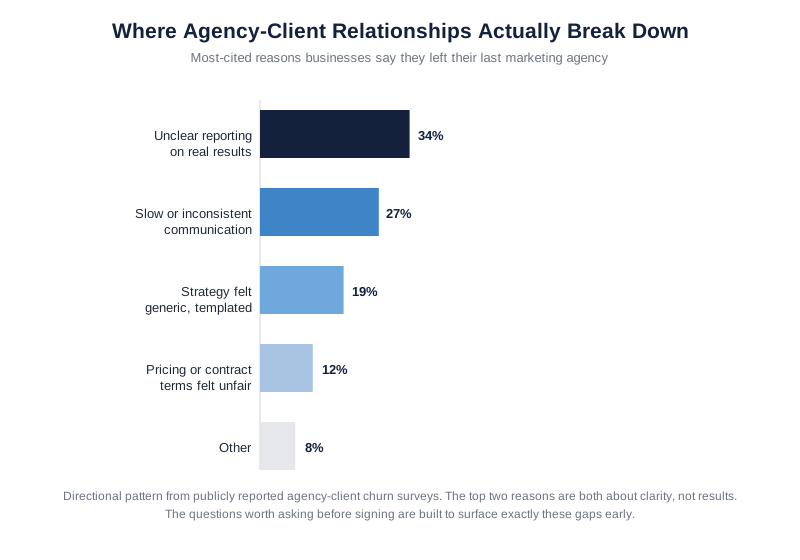
The chart above should reframe how most businesses evaluate agencies before signing. The top two reasons relationships end are not "the work didn't produce results," they are unclear reporting and inconsistent communication, both of which are about clarity, not competence. A genuinely skilled agency that reports vaguely and communicates slowly loses clients at roughly the same rate as a mediocre one, because from the client's side of the table, an unclear result and a bad result are difficult to tell apart. Most of the questions worth asking before signing exist specifically to surface whether an agency has real clarity built into how it operates, not just real skill.
Why the standard evaluation questions miss this
Most businesses evaluating agencies ask some version of "what have you done for clients like us" and "what's included in the retainer," which are reasonable but insufficient questions, because they can be answered convincingly by any agency regardless of whether it actually operates with the clarity that predicts a good long-term relationship. A case study slide answers "have you done this before." It does not answer "will I be able to tell, three months from now, whether this specific engagement is actually working," which is the question that determines whether you end up in the 34% or the 66%.
Red flags worth watching for during the sales process itself, not just in the answers
Some of the most reliable signals show up in how the sales conversation is conducted, not in what is said. An agency that cannot clearly explain, in plain terms, why it would take a specific approach for your specific business, and instead defaults to describing its general methodology regardless of what you have told them about your situation, is often previewing exactly how the engagement itself will run: a standard playbook applied uniformly rather than genuinely adapted to you. Similarly, watch for how questions are handled when they are hard rather than easy. An agency willing to say "we're not the right fit for that specific need" or "that would take longer than a typical engagement" during a sales call, when a harder question comes up, is demonstrating exactly the kind of honesty that predicts good reporting later. An agency that has a smooth, confident answer for absolutely everything, with no acknowledged tradeoffs or limitations anywhere, is worth a second look specifically because real work always involves tradeoffs, and an agency unwilling to name any before you sign is unlikely to become more forthcoming after you do.
The questions that actually surface a mismatch early
"What exactly will I see in a monthly report, and can I see a real, redacted example right now?" Ask for an actual sample, not a description of what reporting includes. Vague answers here, "we'll walk you through the numbers on a call," are a leading indicator of the reporting clarity problem that shows up as the single biggest cause of client attrition. A specific answer, with an actual example in hand during the sales conversation, is a strong positive signal, because it means the agency has already solved this problem for other clients rather than promising to solve it for you.
"How will you show me the difference between correlation and your actual impact?" A rising metric during an engagement does not prove the agency caused it, seasonality, other marketing efforts, and market conditions all move numbers too. An agency with a real answer will describe some form of attribution logic, holdout comparisons, before-and-after trend analysis, channel-specific tracking, rather than simply pointing at an upward graph. An agency without a real answer is setting up the exact ambiguity that later reads as "unclear reporting on real results," even if the work itself was genuinely fine.
"What's your standard response time, and what happens when that slips?" Every agency's pitch deck claims responsive communication. The useful question is what the actual process is when a project slips or a question goes unanswered for a few days, since that is the situation that actually determines whether communication holds up under normal operational pressure, not whether it holds up during a sales conversation when everyone is naturally attentive.
"Walk me through what you'd actually recommend for us, specifically, right now." This is the single highest-signal question in the entire conversation, and it is the one most businesses skip because it feels presumptuous to ask before signing. An agency that has done real diligence on your specific site and situation, rather than a generic industry pitch, will have a specific, evidenced answer ready, often built around at least a lightweight audit of your actual site and current position. An agency offering only generic strategy language at this stage, "we'll focus on content and SEO to drive growth," regardless of what your specific site and market actually need, is telling you plainly that the strategy has not yet been built around your business at all, and may not be, even after you sign.
"Who exactly will be doing the work, and will that person be in this room again?" A common and understandable pattern: the most experienced, most convincing people run the sales process, and a more junior team executes day to day. This is not automatically a problem, junior team members with good oversight can do excellent work, but it is worth knowing explicitly rather than discovering it after signing, since a mismatch between who sold you and who serves you is a frequent, quiet source of the "this doesn't feel like what we agreed to" feeling that surfaces months in.
"What does the contract actually require if this isn't working out?" Notice periods, minimum commitment lengths, and what happens to any assets built during the engagement, ad accounts, published content, tracking setups, if the relationship ends are all worth understanding before signing, not while trying to exit a relationship that has already gone sideways. An agency comfortable walking through this clearly and without hesitation is signaling confidence in its own retention on merit rather than on contractual lock-in, which is itself a meaningful, if indirect, quality signal.
Green flags worth weighting heavily in the other direction
Some signals are worth actively rewarding, not just screening for red flags. An agency that asks you hard, specific questions about your business before offering any recommendation, rather than launching straight into a pitch, is demonstrating the kind of diligence that predicts a genuinely tailored strategy rather than a templated one. An agency that proactively brings up a limitation or tradeoff you had not asked about, "we should mention that this channel typically takes four to six months to show meaningful results, not four to six weeks," is demonstrating exactly the transparency that prevents the expectation gaps behind most churn. And an agency willing to define, in specific and measurable terms, what "working" will look like at 30, 60, and 90 days, rather than leaving success loosely defined until after the engagement starts, has effectively pre-committed to the kind of reporting clarity that the data above shows most relationships are missing.
A worked example: the question that would have prevented a bad fit
A mid-size company hires an agency after a strong pitch: impressive case studies, confident presentation, clear enthusiasm about the account. Three months in, the client cannot tell whether the engagement is working, the monthly report is a screenshot of a Google Analytics dashboard with no interpretation, and two specific questions about strategy went unanswered for over a week each. None of this reflects the actual quality of the SEO or content work being done, which may well be competent. It reflects that the sales conversation never surfaced how reporting and communication would actually work day to day, only that the agency was capable and enthusiastic in the room. Asking for an actual sample report and a real response-time commitment during the evaluation, not after signing, would have surfaced this specific gap in the first conversation, when it was still a reason to negotiate or walk away rather than a reason to churn six months later.
What good answers actually sound like
A strong agency, evaluated against these questions, tends to sound specific rather than aspirational: a real reporting example instead of a description of one, a described method for isolating its own impact instead of a promise that results will show up, a concrete response-time commitment instead of "communication is a priority for us," and a first-pass, evidenced take on your specific situation instead of a generic category pitch. None of these require the agency to be the biggest or most established name in the space. They require the agency to already operate with the clarity that prevents it from becoming one of the two most common reasons clients leave.
Frequently asked questions
Should price be a bigger factor than these questions? Price matters, but a lower-cost agency that communicates clearly and reports transparently is a better long-term bet than a more expensive one that does not, since the value at stake here is largely about whether you can actually tell if the engagement is working, a problem money alone does not solve.
Is it reasonable to ask for a sample report before signing? Yes, entirely reasonable, and a professional agency should have a redacted or anonymized example ready without hesitation. Reluctance to share one is itself useful information about how reporting is likely to go once you are a client rather than a prospect.
What if an agency gives generic answers to the "what would you recommend for us" question? That is a meaningful signal, not a disqualifying one on its own, some agencies reasonably prefer to do deeper discovery before committing to specifics. The distinction worth watching for is between "we'd want to look closer before committing to specifics" and simply repeating the same category-level pitch regardless of what your specific site and situation actually show.
How much should contract length and exit terms weigh into the decision? Meaningfully, and earlier than most businesses consider it. A short, clear notice period with well-defined ownership of any assets built during the engagement reduces the cost of a wrong decision considerably, which matters most precisely when you cannot yet know, at signing, whether this specific relationship will end up in the majority that works or the meaningful minority that does not.
The businesses that end up satisfied with their agency relationship a year later are rarely the ones who picked the most impressive case studies. They are the ones who asked specific enough questions during evaluation to know, before signing, whether the agency operates with the reporting clarity and communication discipline that predicts a good relationship, not just the skill that predicts good work.
Related reading: why manual audits are quietly killing agency close rates, and why a real audit now needs eight surfaces, not four.