E-E-A-T in 2026: How Google and AI Engines Actually Verify Expertise
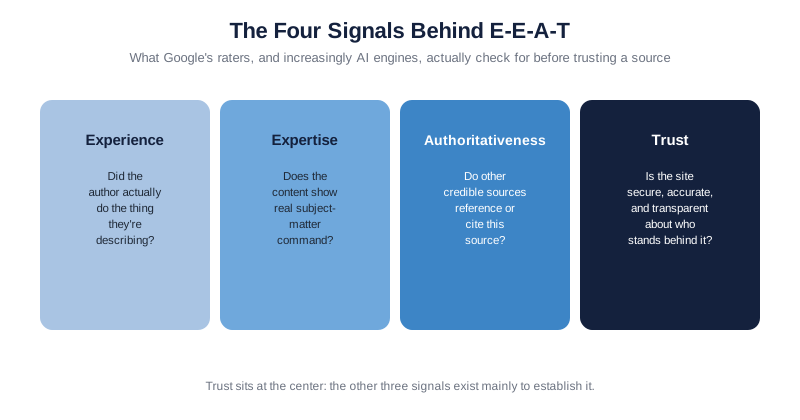
The four signals behind E-E-A-T: Experience, Expertise, Authoritativeness, and Trust, with Trust sitting at the center as what the other three exist to establish
E-E-A-T gets treated as a checklist more often than it gets understood, and that is the source of most of the confusion around it. It is not a scored ranking factor you can tick off like a meta description or a page speed metric. It is a framework Google's human quality raters use, and one increasingly mirrored by the systems behind AI Overviews and generative answers, to judge a more basic question underneath every ranking decision: does this specific source deserve to be trusted on this specific topic. Understanding that distinction changes what actually improving it looks like.
Where the framework came from, and why a fourth letter was added
The original framework was E-A-T, expertise, authoritativeness, trust, and it existed for years as guidance for Google's Search Quality Rater Guidelines before most site owners had heard of it at all. The first "E," experience, was added later, specifically in response to a problem the original three-part framework did not address well: a piece of content can demonstrate expertise, in the sense of using correct terminology and structuring information competently, while being written by someone who has never actually done the thing being described. Raters noticed a growing volume of technically fluent content assembled from other sources rather than from direct, first-hand contact with the subject, and the addition of experience was a direct response to that gap, a way of asking not just "does this sound expert" but "has this person actually lived the thing they are describing."
What each letter is actually checking for
Experience asks whether the author has genuinely done the thing they are describing, not just researched it. A review of a product written by someone who bought and used it reads differently, and is meant to be weighted differently, than a review assembled entirely from other people's reviews and spec sheets. This is the newest addition to the framework, added specifically because search quality raters noticed a flood of technically competent content written by people with no first-hand contact with the subject at all, and readers, and increasingly AI systems, can tell the difference even when the writing quality is otherwise identical.
Expertise asks whether the content demonstrates genuine subject-matter command, correct terminology, awareness of nuance and edge cases, the kind of depth that is difficult to fake convincingly at length. Formal credentials matter more for domains where consequences of bad advice are severe, medical and financial content in particular, and matter comparatively less for domains where demonstrated track record and results speak for themselves.
Authoritativeness asks whether other credible, independent sources treat this one as a reference, through citations, backlinks, mentions in industry publications, or inclusion in comparison content the source did not write itself. This is fundamentally a network judgment, not a self-declaration: a source cannot make itself authoritative by claiming to be, it becomes authoritative when others in the space act as though it is.
Trust sits at the center of the diagram deliberately, because it is not really a fourth, independent input alongside the other three. It is closer to the outcome the other three signals exist to produce. Accurate information, transparent sourcing, clear ownership of who is publishing and why, and a track record free of misleading claims are what actually earn trust, and experience, expertise, and authoritativeness are the evidence used to judge whether that trust is warranted.
Why the bar is higher for Your Money or Your Life topics
Google's rater guidelines explicitly distinguish "Your Money or Your Life" content, topics where inaccurate information could cause real financial, physical, or emotional harm, from lower-stakes content, and E-E-A-T is applied with meaningfully more scrutiny in that category. Medical advice, financial guidance, legal information, and safety-related content are held to a materially higher standard, where formal credentials, cited sources, and clear author identity matter far more than they would for a lower-stakes topic like a recipe or a product roundup. This distinction is frequently missed by businesses applying E-E-A-T advice uniformly across their content, when the actual expectation scales sharply with how much harm bad information in that specific category could realistically cause a reader.
Why AI engines raised the stakes on this rather than lowering them
A reasonable assumption might be that generative AI, capable of producing fluent, confident-sounding text on any topic instantly, would make E-E-A-T less relevant, since the bar for "sounding expert" has collapsed. The opposite has happened, and for a specific reason: AI-generated answers are synthesized from source material, and the systems producing those answers have a direct incentive to weight genuinely trustworthy sources more heavily specifically because the flood of fluent, low-effort AI-generated content has made surface-level fluency worthless as a trust signal. When anyone can produce professional-sounding text on any topic in seconds, the signals that actually separate a real, trustworthy source from a synthetic one, genuine first-hand experience, independent corroboration, a real track record, become more valuable, not less, precisely because they are harder to fabricate at scale.
The problem this content flood is actively creating
Generic AI-generated content, published without genuine first-hand insight behind it, actively damages E-E-A-T signals rather than being neutral toward them. A blog stacked with technically fluent but interchangeable articles, the kind that read as competent but could have been written about any company in the category with a find-and-replace of the brand name, signals the opposite of experience and expertise: it signals that no one with real, specific knowledge was meaningfully involved in producing it. This is measurably worse than publishing less content, because volume without genuine substance behind it dilutes whatever authority a site had built with its earlier, better work, and both search quality raters and generative systems are increasingly tuned to notice the pattern rather than reward the volume.
A worked example: two "how-to" pages on the same topic
Consider two pages targeting the same query, "how to reduce cart abandonment." Page A is well-researched and well-organized, but reads as an aggregation, general best practices restated clearly, no specific numbers, no named examples, no indication the author has ever actually run this kind of test. Page B states plainly, early in the piece, "we tested four checkout flow changes across our own store over three months, cutting abandonment from 68% to 51%, and here is exactly what worked and what did not." Page B demonstrates experience and expertise simultaneously through specificity that cannot be easily produced without having actually done the work, while Page A, however competently written, reads as expertise without experience behind it. Raters are trained to notice this distinction directly, and generative systems extracting citable claims naturally gravitate toward the same kind of specific, first-hand detail, for the same underlying reason: it is more likely to be genuinely true and useful.
A second worked example, across a different industry
The same pattern holds well outside of e-commerce. Consider two law firm blog posts explaining a recent change in employment regulation. One is a competent summary of the new rule, accurate and clearly written, but structurally indistinguishable from dozens of similar summaries published the same week across other firms' sites. The other includes a specific note from the attorney who wrote it: "we've already advised six clients on how this affects existing severance agreements, and the most common mistake we're seeing is X." The second post demonstrates experience, a real, current, first-hand encounter with the practical consequences of the rule, in a way the first post, however accurate, cannot claim. This is precisely the kind of distinction that scales across industries: the specific, first-hand detail is what E-E-A-T is designed to reward, regardless of the topic.
What actually improves E-E-A-T, concretely
Publish genuine first-hand results, specific numbers, named examples, real outcomes from your own work, rather than general industry commentary indistinguishable from a hundred similar posts. Make authorship and expertise visible rather than anonymous: a real byline with a real, checkable background does more for trust signals than any structured data markup ever will. Earn genuine third-party mentions rather than only publishing on owned channels, a mention in an independent comparison article or industry publication is a stronger authoritativeness signal than the same claim repeated on your own site ever will be. And be transparent about sourcing, methodology, and limitations rather than presenting every claim with uniform, unqualified confidence, since raters and increasingly AI systems both weight appropriately hedged, specific claims as more trustworthy than sweeping, unqualified ones.
A simple internal audit for existing content
For any page you suspect is underperforming despite reasonable topical relevance, ask four direct questions in order. Does this page state, anywhere, that the author or business has actually done the thing being described, rather than only explained it. Does it contain at least one specific number, named example, or concrete detail that a generic competitor page on the same topic would be unlikely to have. Is there any independent source, outside your own domain, that corroborates the central claim. And is the authorship clear, attributable, and checkable, rather than anonymous or generic. A page failing two or more of these is a stronger candidate for a genuine rework than a page failing only one, and the rework that matters is adding real substance, not restructuring the same general claims into a cleaner format.
Frequently asked questions
Is E-E-A-T a direct Google ranking factor? Not in the sense of a single scorable input. It is the underlying framework quality raters use to evaluate pages, and a strong body of correlational evidence links the underlying practices, genuine expertise, real corroboration, transparent sourcing, to better rankings over time, even without a single named "E-E-A-T score" anywhere in the algorithm.
Does my business need named, credentialed authors on every article? For sensitive topics, health, finance, legal, and safety content, yes, this matters significantly. For most commercial content, a real, consistent author identity with a genuine, checkable background matters more than formal credentials specifically, though both help.
Can a small business realistically compete on authoritativeness against large, established brands? Yes, through depth and specificity in a narrower niche rather than breadth. A small business with genuine, specific, first-hand expertise in one narrow area can out-signal a large brand's generic content in that specific niche, because authoritativeness is judged topic by topic, not company size by company size.
Does E-E-A-T apply the same way to every type of content? No, the bar scales with potential harm. Your Money or Your Life topics, medical, financial, legal, and safety content, are held to a materially higher standard than lower-stakes commercial content, and the practical implication is that businesses in those categories should invest more heavily in credentialed authorship and cited sourcing than a business publishing a product roundup would need to.
E-E-A-T rewards exactly what generic, mass-produced content cannot fake convincingly: real experience, specific expertise, independent corroboration, and transparent trust. That was true before generative AI accelerated content production, and it has become more decisive, not less, now that fluent-sounding text is nearly free to produce and genuine substance is the only thing left that reliably tells the two apart.
Related reading: generative engine optimization (GEO) and why SEO alone isn't enough, and why ChatGPT doesn't know your business exists.