The Cross-Surface Blind Spot: Why Your Marketing Reports Are Technically Correct and Still Wrong
The seven surfaces of digital presence: Website, Content, SEO, Social Media, Paid Advertising, Reviews & Reputation, and AI Engine Visibility, the full picture buyers see when researching a business online
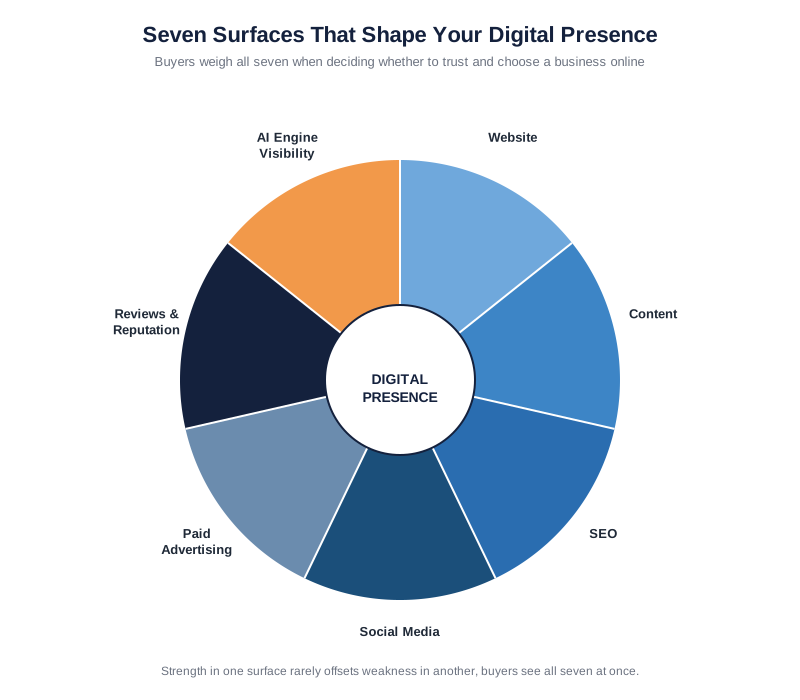
Every dashboard your marketing team looks at can be green and your business can still be losing customers it should be winning. This is not a contradiction, and it is not a measurement error. It is what happens, reliably, when you measure surfaces individually instead of measuring the relationships between them. Google Analytics tells you the site converts fine. Your SEO tool tells you rankings are climbing. Your social scheduler tells you engagement is up. Your ads platform tells you cost per click is within target. Every one of these reports is telling the truth about its own slice, and none of them is architecturally positioned to notice the specific thing that is actually costing you customers.
Why single-surface tools cannot see this by design
A tool built to measure one surface cannot find a problem that only exists in the gap between two surfaces, and this is not a criticism of the tools, it is a description of what they were built to do. An SEO platform's entire job is to tell you about SEO. It has no visibility into what your reviews say, whether your paid ads contradict your organic messaging, or whether AI engines are recommending a competitor instead of you. The blind spot is not a bug in any single tool. It is the space between all of them, and by definition, nobody owns that space unless someone deliberately builds a process to look there.
This is also an organizational problem, not just a tooling one. Most marketing teams are structured by channel: an SEO specialist, a social manager, a paid media buyer, someone handling reviews and support. Each person is measured on their own surface's numbers, reasonably so, since that is what they control. But this means every individual can hit their target while the composite experience a real buyer encounters, moving across all of these surfaces in a single research session, is quietly incoherent. Nobody's job description includes "notice that the sum of everyone doing their job well still loses to a competitor with a worse dashboard but no internal contradictions."
Three failure modes, and how each one actually shows up
Contradictions. This is the clearest and most common pattern: a business investing heavily in content marketing while its review profile actively undermines the trust that content is trying to build. Consider a hypothetical but entirely typical example. A company publishes a strong blog post claiming its onboarding is "fast and painless," and that post ranks well and drives real traffic. Meanwhile, its three most recent Trustpilot reviews, visible on the very next tab a careful buyer opens, describe onboarding as confusing and slow. Neither surface is broken on its own. Content hit its publishing calendar. Support eventually responded to the reviews. But a buyer doing real diligence sees both within minutes, and the contradiction costs more trust than either surface alone would suggest, because now the buyer isn't just weighing one data point, they are weighing your own inconsistency. Review credibility research backs up how much weight this carries: 65% of consumers say they are more likely to choose a business that responds to its reviews, and response behavior alone is associated with an average 4.1% conversion lift for every 25% increase in response rate (GatherUp, 2025; industry review studies, 2026). A visible, unaddressed contradiction between your content and your reviews spends down exactly the trust capital that responsive review management builds.
Compound effects. Weak spots in different surfaces often reinforce each other in ways that are worse than the sum of their parts, because several of these surfaces are literally each other's raw material. A thin content library, a small review footprint, and low AI engine visibility are not three separate small problems, they are one large problem, because AI engines cite review platforms and roundup articles, and roundup articles cite companies with visible reviews and enough published content to reference confidently. Weakness in one surface starves the others of the material they need to represent you well. This is measurable: earned third-party content (the kind that comes from having a real review presence and being included in comparison roundups) outperforms brand-owned content by roughly 325% for AI citation purposes. A business with no review presence isn't just missing reviews. It is quietly suppressing its own AI visibility and its own inclusion in the roundup content that both search engines and AI engines reward.
Strategic misalignment. Sometimes the surfaces are not contradicting each other, they are simply pointed in different directions. A common version: a company runs aggressive paid acquisition toward a self-serve signup flow, while its actual product realistically requires a sales conversation to close a meaningful deal. The paid team hits its cost-per-lead target every month. The sales team quietly wonders why almost none of the inbound leads convert. Both teams are doing their job correctly, by their own dashboard's definition. The mismatch is strategic, not tactical, and no single-surface report will ever flag it, because from inside either surface, everything looks fine.
A worked example of what this looks like end to end
Picture a mid-market software company six months into a growth push. Their SEO dashboard shows keyword rankings up 40%. Their content calendar has shipped weekly for two quarters. Their paid team reports a stable cost per click. In isolation, every number supports "things are working." Now overlay the surfaces. The content ranking well targets informational, top-of-funnel keywords almost exclusively, none of it addresses the two comparison queries where their two closest competitors are already ranking. Their G2 listing has eleven reviews, all more than a year old, while both named competitors have upward of eighty, recent, and steadily accumulating. And a quick AI visibility check across ChatGPT and Perplexity shows the company is never mentioned by name in response to "best tools for [their category]," while both competitors appear consistently. None of this shows up as a red flag in any single dashboard. Rankings are up. Content is shipping. CPC is stable. But the composite picture is a business that is discoverable for the wrong queries, thin on the third-party proof buyers actually check, and functionally invisible in the fastest-growing research channel. That is the story only a cross-surface view tells, and it is the story that determines whether the next two quarters of growth spend actually convert.
What a genuine cross-surface view requires
Finding these patterns requires three things most organizations do not have set up by default: a consistent scoring framework across surfaces so they are comparable rather than measured in incompatible units (a keyword count and a star rating cannot be directly compared without some normalization), competitor data pulled at the same time and through the same lens so gaps read as relative rather than abstract, and someone, or something, whose actual job is to look across the surfaces rather than deep within just one of them.
A simple audit you can run this week
You do not need seven dashboards and a data team to start. Pick your three most important buyer-facing surfaces, for most businesses that is organic content, reviews, and whatever channel currently drives the most pipeline, and ask one question about every pair of them: does what we say here match what shows up there? Walk the exact path a skeptical buyer would: read your best-ranking content, then immediately check your most recent reviews, then search your brand name alongside a competitor's in an AI assistant. Write down every place the story changes. That list is your cross-surface audit, and it usually surfaces more urgent, more fixable problems than another round of on-page optimization within any single surface.
Frequently asked questions
How is this different from a typical marketing audit? Most audits go deep on one channel (an SEO audit, a paid media audit, a content audit). A cross-surface audit deliberately goes wide first, scoring every surface consistently, then specifically hunts for contradictions and compound effects between them before going deep on any single one.
How often should this be re-run? Quarterly at minimum. Reviews, AI citations, and competitor positioning all shift meaningfully within a single quarter, and a cross-surface view that is a year old will miss new contradictions that have since appeared.
Does this replace channel-specific expertise? No. It complements it. A channel specialist still needs to execute the fix once a cross-surface audit identifies where the misalignment is. The audit's job is to find the right problem to work on, not to replace the people who solve it.
This is exactly the exercise a full digital presence diagnostic is built to run systematically: scoring each surface on its own terms, then specifically looking for the contradictions, compound effects, and misalignments that only exist in the white space between them. The individual scores matter less than what emerges when you put them side by side. That is usually where the real story, and the real opportunity, is hiding.
Related reading: why a real audit now needs eight surfaces, not four, and competitor analysis belongs in every audit.